


In the interest of full disclosure, we believe that the following are the ways you should vote on the three Burbank measures on your ballot:
- NoMeasure C
- YesMeasure CC
- YesMeasure CD
Patrick Prescott, Community Development Director
City of Burbank
150 North Third Street
Burbank, California 91502
Dear Mr. Prescott, Ms. Becker, Ms. McFarland and Ms. Hamzoian,
Our legal team has reviewed the City’s Measure C advertising and its Measure C mailer and has determined that they are campaign materials paid for with public money, in violation of Government Code section 54964. We respectfully ask that the City take them down now and make no further paid promotion of Measure C.
Your June 16 staff report recommended that the City Council place Measure C on the ballot. The City’s March 10 mid-year budget, presented by the Financial Services Director, set aside $92,500 for Pivotal Strategies to provide “public education and outreach for a potential Transient Occupancy Tax (TOT) ballot measure” and $82,000 for FM3 to survey voters on it. When a city hires a pollster and an outreach firm for a tax that is not even on the ballot yet, it is not planning a civics lesson.
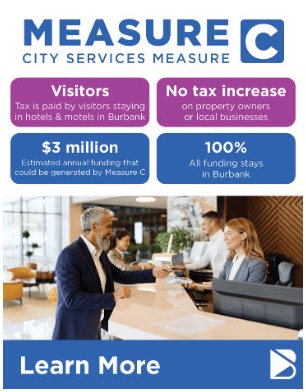
On October 13, three weeks before Election Day, a local website carried a City advertisement for Measure C that links to the City’s Measure C page. It is not a notice. It is a sales pitch: a logo, four reasons to like the tax and a smiling hotel clerk checking in a guest.
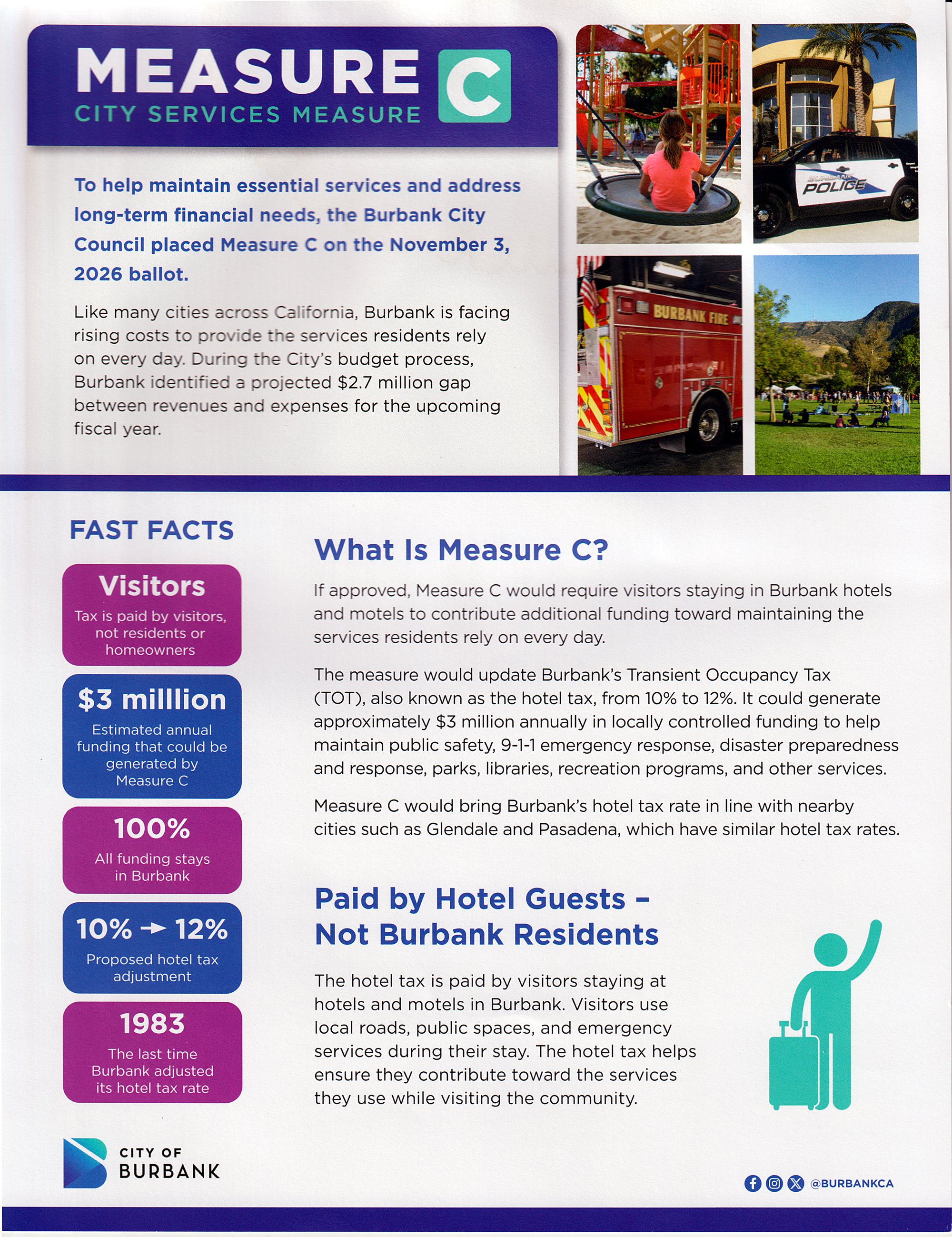
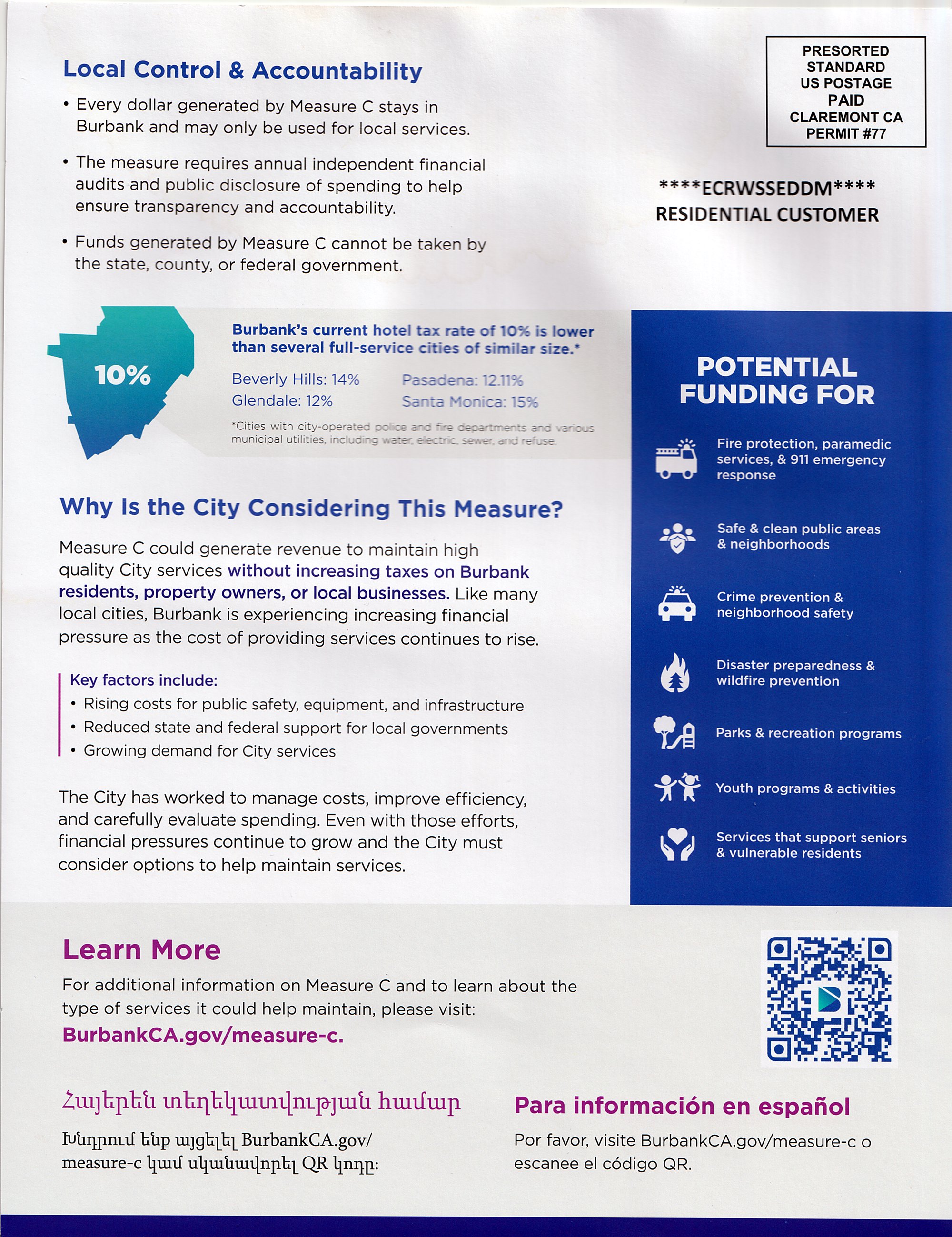
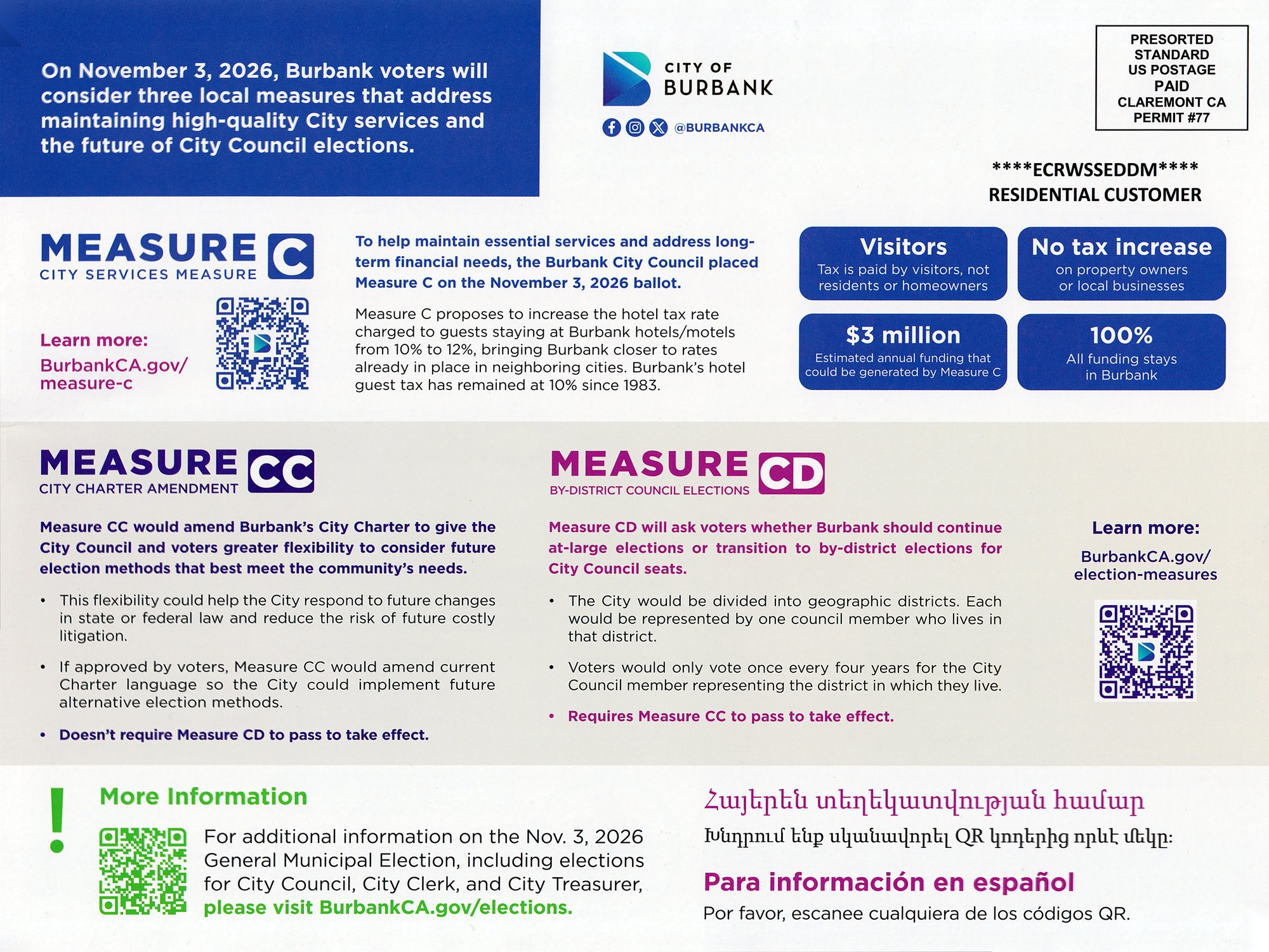
The City did not stop at the website. It also mailed a flyer to Burbank homes, addressed to “Residential Customer.” Its headline reads “Paid by Hotel Guests – Not Burbank Residents,” and it promises the money comes “without increasing taxes on Burbank residents, property owners, or local businesses.” A full-color mailer to Burbank households is not cheap.
Where the City’s $272 million comes from
City of Burbank General Fund revenue budgeted for fiscal year 2026-27, in millions of dollars.
Taxes you already pay
- Property tax$85.9M
- Sales tax$60.9M
- State and federal money$2.4M
Local taxes, fees and charges
- Charges for City services$30.0M
- Other taxes, fines and fees$24.8M
- Utility users tax$22.4M
- Hotel tax$14.6M + about $3M with Measure C
- Water and Power transfer$11.8M
Property and sales tax alone bring in $146.8 million, 54% of the total. Measure C would add about $3 million, roughly 1%. This is not a city running out of money.
Source: City of Burbank, Fiscal Year 2026-27 Proposed Budget at a Glance. Not shown: $19.3 million the City bills its own departments.
Measure C is a tax on housekeepers. A family planning a trip to Burbank has a budget, and it does not grow because the City raised its hotel tax. When the tax goes up, something else gives: the room rate the hotel can charge, the nights it can fill, and the hours it can give the people who clean the rooms. That makes it a tax on the business and a tax on the housekeeper. Even the City Attorney’s impartial analysis says the tax is paid by guests who are only “primarily visitors.”
The biggest claim in your ad is printed in big, bold letters: “No tax increase.”
The small print underneath says on property owners or local businesses, and your mailer repeats it. We consider that headline false and both pieces misleading, and we believe it warrants further investigation, not only by the Fair Political Practices Commission but by the Los Angeles County District Attorney’s Public Integrity Division. The Commission’s own rules warn that campaign activity paid for with public money “may be illegal” and point to Penal Code section 424. A tax that comes out of a hotel’s rates and a housekeeper’s hours is a tax increase on both, whatever line of the bill it is printed on.
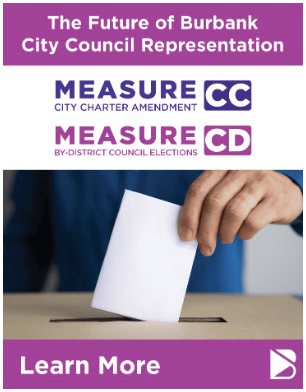
Compare the two ads the City ran in the same ad space on the same website. The Measure C ad is a full sales pitch. The ad for Measures CC and CD names the measures, shows a ballot and says Learn More. We will not guess at how the City feels about Measures CC and CD. We will only note that the measure that brings the City $3 million a year got the sales pitch, and the other two got a Learn More button. The City’s own web pages show the same difference: the page for CC and CD lays out every possible outcome, while the page for Measure C asks “Why is a hotel guest tax the best option?” and offers only reasons to vote yes. You know how to inform voters.
What the law says
California law does not allow a local agency to spend public money to support a ballot measure (Government Code section 54964). In Stanson v. Mott (1976) 17 Cal.3d 206, the California Supreme Court held that “in the absence of clear and explicit legislative authorization, a public agency may not expend public funds to promote a partisan position in an election campaign,” because “the government may not ‘take sides’ in election contests or bestow an unfair advantage on one of several competing factions” (id. at p. 217). Where a communication comes close to the line, the answer “depends upon a careful consideration of such factors as the style, tenor and timing of the publication” (id. at p. 222). By “partisan,” the Court did not mean Republican or Democrat. It meant taking one side of an election, and a ballot measure has two sides.
In Vargas v. City of Salinas (2009) 46 Cal.4th 1, the Court reaffirmed Stanson and named the kinds of spending that are not authorized even when they never say vote yes: materials that “reasonably are characterized as campaign materials or activities – including, for example, bumper stickers, mass media advertisement spots, billboards, door-to-door canvassing, or the like.” A paid advertisement on a commercial website is a mass media advertisement spot.
The Fair Political Practices Commission draws the same line. Under its Regulation 18420.1, public money spent on a communication that “taken as a whole and in context, unambiguously urges a particular result in an election” is an independent expenditure, and an agency that qualifies as a committee “must file campaign statements and reports.” The regulation treats “mass media advertising including, but not limited to, television, electronic media or radio spots” as campaign material outright. It counts the cost of “polling or research” and of “consultants” as part of the communication. And in judging style, tenor and timing, it asks whether a piece was “funded from a special appropriation related to the measure” and whether it “is consistent with the style of other communications issued by the agency.”
Measure each of your pieces against that list. The money came from a special appropriation made in March for this very measure, including a pollster. The web ad is electronic media advertising. The mailer went to Burbank homes with the same selling points. And neither piece looks anything like the City’s material on Measures CC and CD. We are not aware of any campaign statement the City has filed for any of it.
A better use for the money
There was a better use for this money. We had already recommended that the City put voting information out through Burbank Water and Power, which reaches every household at no extra cost, telling voters when, where and how to vote and leaving the arguments to the campaigns. Nobody can object to a city that helps people vote. Plenty of people object to a city that tells them how.
We ask that the City remove the Measure C advertising, make no further paid promotion of Measure C, and preserve every record about the advertising, the mailers, and its work with Pivotal Strategies and FM3 while this matter is open. We believe it warrants investigation, and those records will matter.
Public money does not become a campaign fund just because the campaign happens to be yours.
Yours sincerely,
The Burbank Republican Party
The City’s other mailers
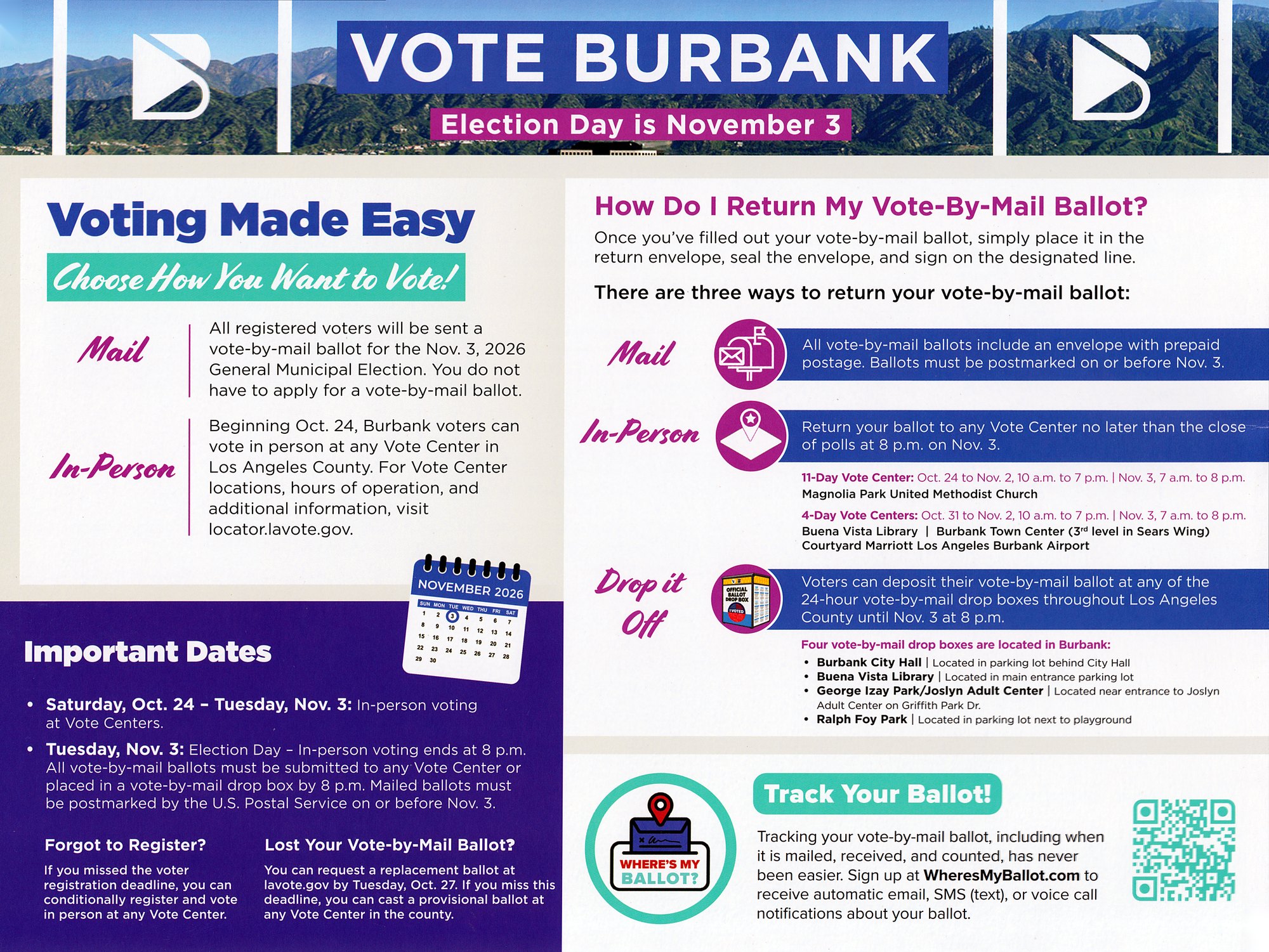
The City also sent two other mailers to Burbank homes, both addressed to “Residential Customer.” The first, titled “Vote Burbank,” covers all three local measures on its back page. Measure C gets the same four selling points as the City’s web ad: “Visitors,” “No tax increase,” “$3 million” and “100%” staying in Burbank. Measures CC and CD get a plain description of what each one does.
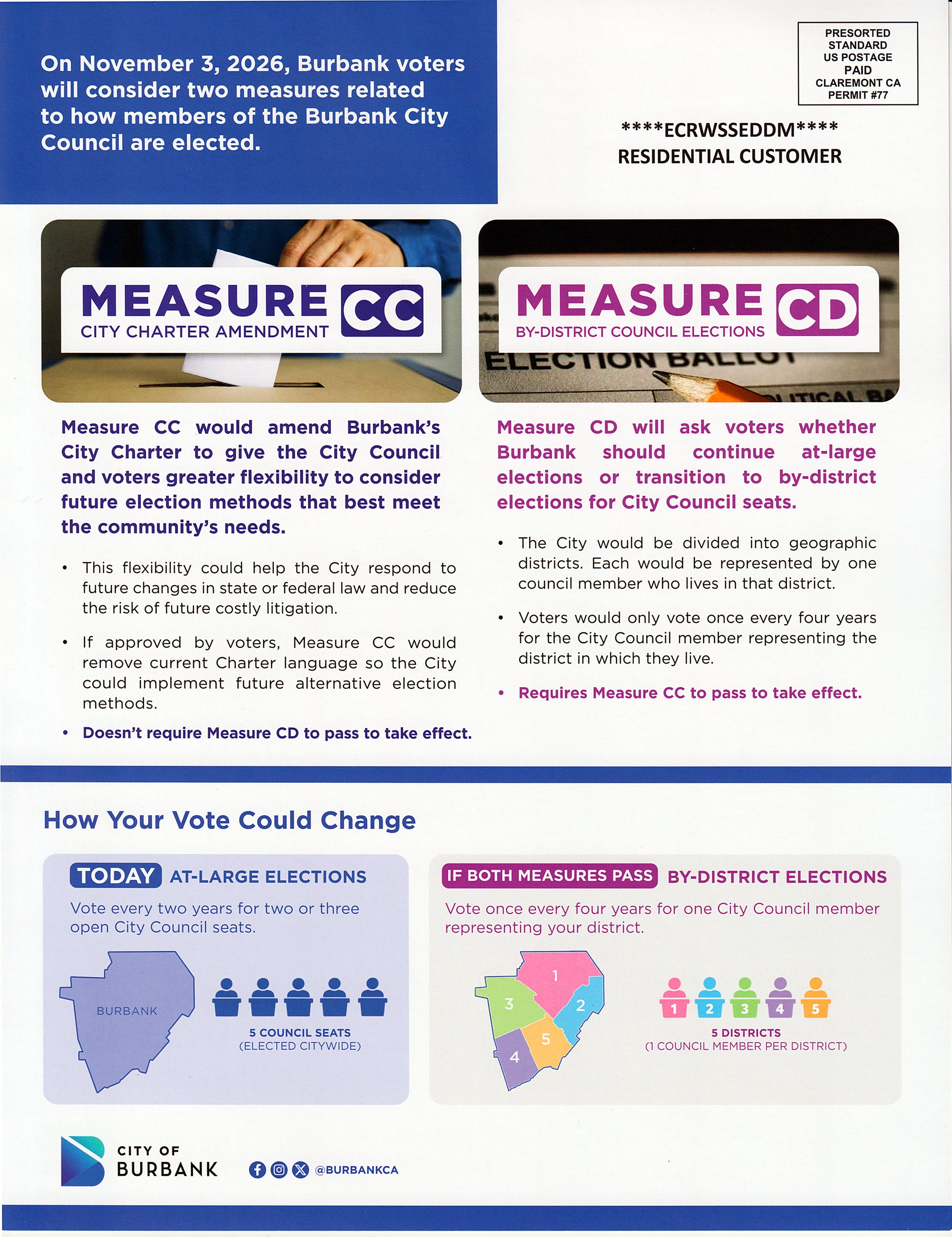
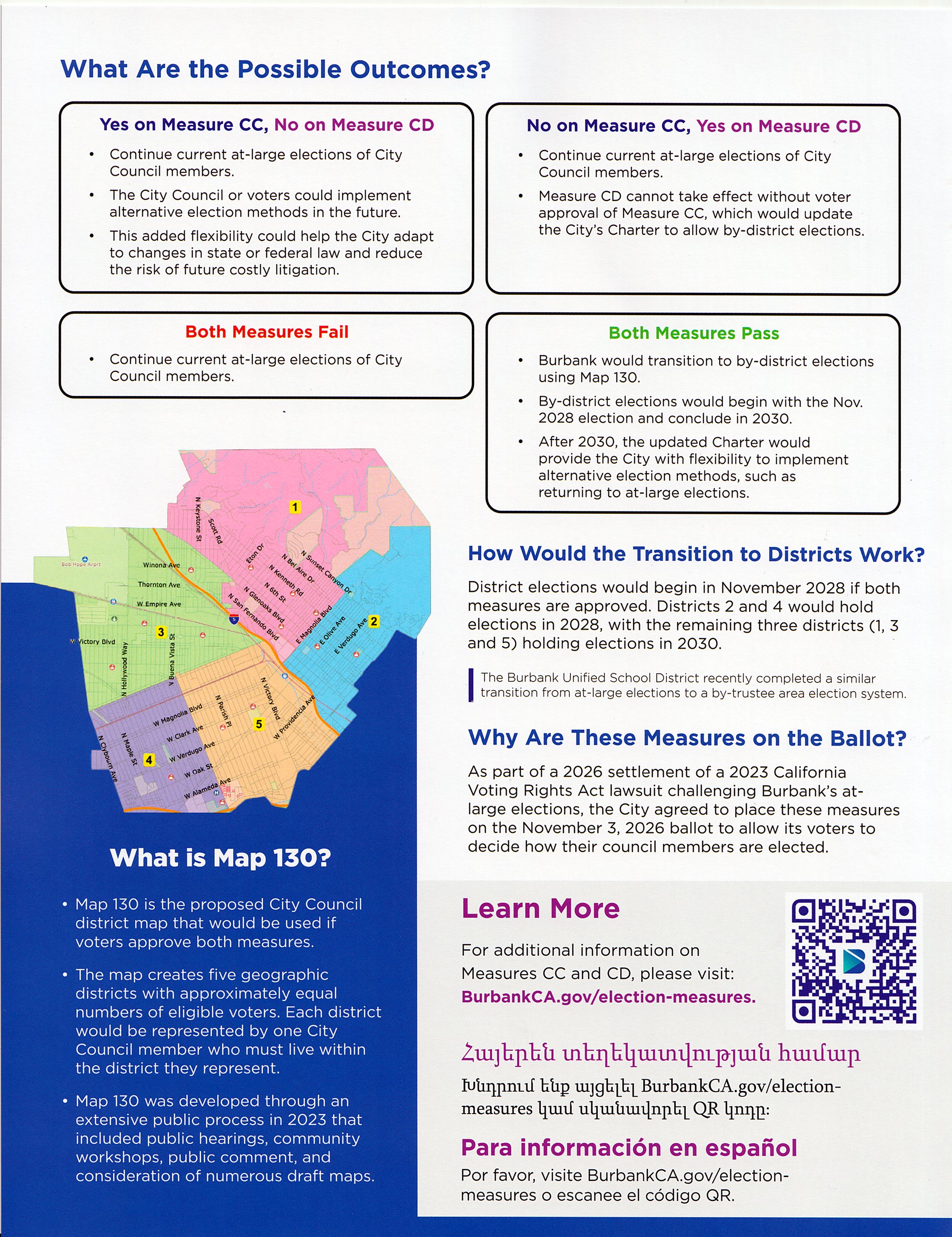
The other is devoted to Measures CC and CD. It explains what each measure would do, lays out all four possible outcomes and shows the proposed district map. Put it next to the Measure C mailer above and the difference is plain: one explains, the other sells.
Election Day is Tuesday, November 3, 2026, and polls close at 8 p.m. Here is how we believe you should vote on the three Burbank measures:
- NoMeasure C
- YesMeasure CC
- YesMeasure CD
Sources
- City of Burbank staff report, June 16, 2026, recommending a general tax measure for the November 3, 2026 ballot.
- City of Burbank mid-year budget requests, March 10, 2026 (Attachment 5), adopted with Resolution 26-29,691.
- City of Burbank advertisements for Measure C and for Measures CC and CD on a local website, viewed October 13, 2026.
- City of Burbank Measure C mailer, the “Vote Burbank” mailer and the Measures CC and CD mailer, all mailed to Burbank residents.
- City of Burbank, Fiscal Year 2026-27 Proposed Budget at a Glance, General Fund revenues by source.
- City of Burbank compensation disclosure, fiscal year 2025, received May 27, 2026, through Paystub, the Burbank Republican Party’s payroll lookup.
- Stanson v. Mott (1976) 17 Cal.3d 206, and Vargas v. City of Salinas (2009) 46 Cal.4th 1, Supreme Court of California.
- Fair Political Practices Commission Regulation 18420.1, California Code of Regulations, title 2, section 18420.1; Government Code section 54964.