


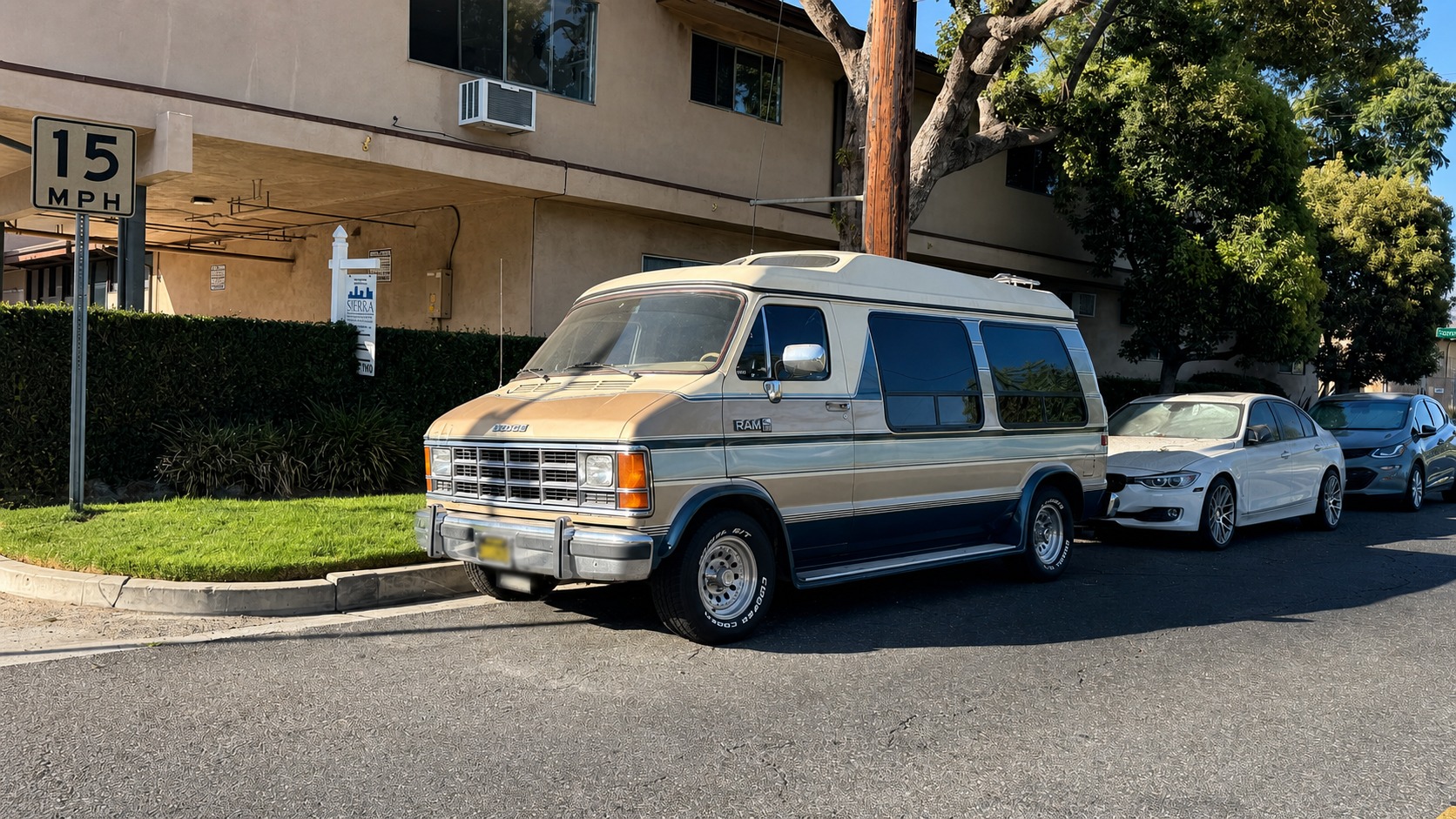
A word before we begin
This document says plainly what many Burbank residents say privately. It is written without malice toward any person. Genuine homelessness is a tragedy, and Burbank’s truly needy — our neighbors who lost a job, a lease, or their health — deserve real help.
That is exactly the point. Every dollar, every meal, and every parking space consumed by a voluntary transient is a dollar, a meal, and a parking space taken from a Burbank resident who actually needs it. Compassion without discernment is not compassion. It is negligence with good manners.
The problem, stated honestly
A distinct and growing population has discovered a simple arbitrage: drive a van or RV into a well-run, generous city, park on a residential street, and consume the services that city taxpayers built for their own vulnerable neighbors — free meals, hygiene services, charitable giveaways, and public infrastructure — while paying nothing into the system that provides them.
Many of these individuals are not destitute. “Van life” is a celebrated national lifestyle movement — the #vanlife tag has accumulated billions of views on TikTok and millions of posts on Instagram — in which participants, some with remote incomes and expensively converted vehicles, romanticize rent-free living on other people’s streets. Bay Area reporting has documented vehicle dwellers who hold jobs, including well-paid technology jobs, and who chose to “downsize” onto the public right-of-way.
When Los Angeles moved toward a citywide RV parking program in 2024, a council member put it in seven words: our city is not an RV park. Even famously progressive San Francisco concluded in 2025 that it had to ban long-term RV dwelling on its streets. Palo Alto and Mountain View residents have asked in their local papers why they must pay property taxes, school bonds, and utility assessments to subsidize people who live curbside by choice and pay nothing.
They did not fall through our safety net. They drove to it.
Burbank is a well-run city with generous charities, safe streets, and free parking. That makes us a magnet. People arrive from out of the area, out of the county, and out of the state — not because Burbank failed them, but because Burbank works.
What it costs
The burden is real and layered. Charitable food and services intended for indigent Burbank residents are consumed by the mobile and the able. Residential street parking — already scarce — is occupied for days or weeks by oversized vehicles. Sanitation problems follow: neighboring cities have documented waste dumped into storm drains and onto parkways. Police and code enforcement hours are diverted. And every service consumed by a voluntary transient stretches thinner the resources available to the genuinely homeless Burbank resident the system was built for.
Communities up and down California are reaching the same conclusion at once, from Los Angeles to San Francisco: the era of pretending this is cost-free is over.
The old lesson we unlearned
For most of American history, communities held a simple principle: you may pass through, you are welcome to visit, but you may not set up residence on the public street and live off the commons. When the courts swept away the old vagrancy framework in the 1970s, they were right to strike down laws that were vague and unevenly enforced — but the baby went out with the bathwater. Cities lost lawful, neutral tools to distinguish between a resident in crisis and a traveler exploiting local generosity. The result is visible on every California curb.
The good news: in City of Grants Pass v. Johnson (2024), the Supreme Court restored broad authority for cities to enforce neutral, generally applicable rules about camping and living on public property. The tools are back. The only question is whether we will use them.
Our principles
- Residents first. Burbank’s services exist for Burbank’s people. Charity begins at home because that is the only place it can be sustained.
- Neutral rules, evenly enforced. We do not target any person or class. We enforce parking, habitation, and sanitation rules that apply to everyone, everywhere in the city, equally.
- Honesty about choice. A person with income, options, and a functioning vehicle who chooses curbside living is not homeless in any meaningful sense, and public policy should stop pretending otherwise.
- Real help for the truly needy. Verification is not cruelty. Directing aid to verified local need is how aid survives.
The plan
Phase one — enforce the laws Burbank already has
No council vote required.
- Large vehicle permits, enforced on sight. BMC § 6-1-1010.1 already prohibits any house car, pick-up with camper, recreational vehicle, or trailer measuring 22 feet or more in length — or 8 feet in height or width — from parking on any public right-of-way unless a valid permit is properly displayed. Each permit runs 24 hours; no more than three may be used back to back, capping a stay at 72 hours; at least 48 hours must pass before the next block begins; and no vehicle may receive more than 96 permits in a calendar year. The same section bars these vehicles within 80 feet of any intersection. A violation is an infraction enforced through the state parking-penalty process. An unpermitted RV is citable immediately. We will demand this ordinance be enforced as written.
- The 72-hour rule, without the loophole. BMC § 6-1-1010 bars storing any vehicle on a street for more than 72 consecutive hours — and expressly treats shuffling within the same block as a single act of parking. The “move it ten feet” trick is already illegal in Burbank. Police may tow at 72 hours. We will ask why they so rarely do.
- A public enforcement audit. The Burbank Republican Party will file public records requests for large-vehicle citations, 72-hour tows, and overnight-zone citations over the past 24 months, and publish the results. If complaints are up and citations are flat, the public deserves to know that the city has the tools and declines to use them.
- A resident reporting campaign. Our one-page guide is published below. It tells residents where to report, what to write down, and exactly which code section to cite, so every complaint lands enforceable and specific.
- Administrative action. Burbank’s code already lets city administrators act without a council vote: overnight restrictions in certain commercial and industrial zones (BMC § 6-1-1028) and posted restrictions where parked vehicles create hazards or obstruct access (BMC § 6-1-1029). We will formally request both at known congregation sites, and ask the City to confirm in writing which department holds each authority.
Phase two — close the gap
Council action required.
- A vehicle-habitation ordinance. Burbank has no ordinance directed at living in a vehicle on our streets. Los Angeles closed that gap with Municipal Code § 85.02, which bars dwelling in a vehicle between 9:00 p.m. and 6:00 a.m. on any residential street, and at any hour within one block of a park, school, preschool, or daycare. That drafting is deliberate, and it is the lesson Burbank should copy: the Ninth Circuit struck down an earlier, broader version of § 85.02 in 2014 as unconstitutionally vague, and Los Angeles replaced it with the current time-and-place framework. A Burbank ordinance should be written the same way — specific as to hours, distances, and conduct — and grounded post-Grants Pass in sanitation, public safety, and preservation of residential parking.
- Residency-prioritized services. City-funded homeless services should verify local ties and prioritize Burbank residents, so that our aid reaches the neighbor in crisis before the traveler passing through.
Phase three — tell the truth in public
Ongoing.
- Document the trend. We will compile published reporting — not private individuals’ videos, but established press coverage — showing that a visible share of vehicle dwellers are voluntary participants in a lifestyle movement, not indigents, and present it to the Council and the community.
- Say it out loud. Through The Record, public comment, and community forums, we will keep making the argument most officials will not: generosity that cannot say no to exploitation will eventually have nothing left to give to anyone.
What we are not doing
We are not criminalizing poverty. We are not targeting any individual. We are not proposing to deny food or shelter to any genuinely destitute person. We are insisting on the oldest civic bargain there is: a community’s generosity is for its members and its genuine emergencies — not a subsidy for anyone with a van, a phone, and a preference for living free at someone else’s expense. A city that cannot make that distinction will lose both its generosity and its streets.
The ask
We call on the City Council, the City Manager, the Chief of Police, and the Community Development Director to enforce the ordinances on the books, publish enforcement data, and bring forward a vehicle-habitation ordinance modeled on Los Angeles § 85.02 before the end of the year. Burbank’s residents built this city, fund this city, and deserve a government that puts them first — politely, lawfully, and without apology.
Reporting a violation: the one-page guide
Print it, keep it by the door, and hand it to a neighbor. It lists the three ways to report, what to note down before you call, and the exact Burbank Municipal Code section to cite for each kind of violation — because “BMC 6-1-1010.1(B), no permit displayed” is far harder for the City to close out than “there is an RV on my street.”
Respectfully,
The Burbank Republican Party